Our Research on Microbot Medical Reveals A Bleak Reality For Investors
Microbot Medical (MBOT) is a medical device company with only one product: the LIBERTY Endovascular Robotic System. The LIBERTY is an FDA-cleared, single-use, remote-operated system that allows physicians to perform peripheral vascular procedures from a station. The stated benefits are for the physician to improve precision and reduce radiation exposure and physical strain.
The LIBERTY received FDA 510(k) Clearance on 9/8/25. The full market release (FMR) of the LIBERTY recently began on 4/13/26. The device is still new and whether it will become a commercial success or failure is still unknown to most investors.
We started off our research hoping that it would be a game changer for vascular surgeons. We heard that some doctors, who had never used the device, were excited about the release and thought it would be a great advancement in vascular surgery and that MBOT would potentially be acquired by a larger medtech company. If that was the case, the stock appeared undervalued with the company already having a large cash position.
We were looking to possibly long the stock into the LIBERTY launch and publish a bullish report on our findings. However, after we conducted investigative interviews, the evidence combined with our research flipped our sentiment from bullish to bearish.
We are short MBOT.
We Interviewed Several LIBERTY and Microbot Medical Insiders
We spoke with 2 surgeons who have used the device. One requested to remain anonymous. The other didn’t mind us using his name. He is Dr. Charles Briggs from Tampa General Hospital.
We also interviewed a former employee of MBOT. He requested anonymity.
One of our analysts is a PHD in Medical technology, that has worked on many of our previous reports about medical devices over the years. He did research on MBOT and the LIBERTY and found many drawbacks to the technology that we include in this report.
We Interviewed Two Surgeons Who Have Used The LIBERTY And They Had The Following Complaints
The following are the main drawbacks to the LIBERTY that we found from our research and interviews with the surgeons:
- The technology is not fully integrated into procedural flow. It is not compatible with .018” guidewire which is the main tool used for peripheral vascular procedures.
- The physician and/or technician has to assemble/disassemble the LIBERTY during the procedure, which adds about 15 minutes to the case.
- When .018” wire is used, the clinical personnel has to wear lead vests, which minimize the only advantage the LIBERTY offers – a reduction in radiation. Even a clinical publication on the initial 20 patients is modest about the evidence due to the single arm study design.
- There is no reimbursement for the $3K-$4K expensive LIBERTY disposable. Therefore, the hospital is expected to cover the LIBERTY expense. However, most peripheral cases are barely profitable and there is no money to pay for the LIBERTY disposable expense.
- MBOT’s attempts to convince the investor that a new NTAP reimbursement code can be obtained is unrealistic, because the key requirement for the NTAP code is that the technology has substantial clinical benefits to the patient, which LIBERTY does not. It needs to be an inpatient procedure, to qualify for an NTAP code. The overwhelming majority of peripheral vascular procedures LIBERTY is used for are outpatient procedures.
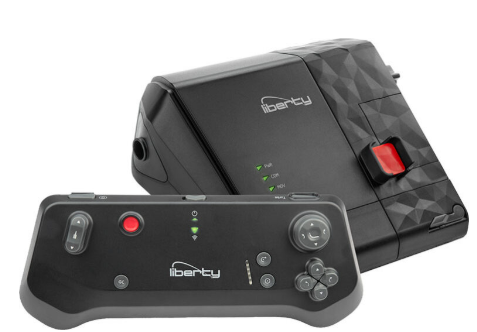
- Incredibly, the entire LIBERTY system is disposed of after only being used once. Even the LIBERTY remote control and drive unit are thrown away every time. That’s very wasteful for both the hospital and MBOT.
We were surprised to read that Gadot confirmed this in this article. The article states:
The wireless controller sends commands, steering the guidewire or catheter held and manipulated by the robotic drive, which is attached near the patient’s bedside by the mounting arm. When the surgeon is done with the procedure, they throw the entire system away.
The following is a picture of the remote control and drive unit taken from the article:
Quotes From White Diamond Research’s Interview With The First Surgeon Regarding the LIBERTY
The conversation with the first surgeon regarding the LIBERTY didn’t go the way we expected. It went from us asking how good the LIBERTY is to the surgeon telling us how bad it is. This was how it started:
White Diamond Research Analyst (WDR) : Yeah, and listen, like, totally up to you if you want to be ‘on the record’ or ‘off the record’ as anonymous, um, but what we like to do is circulate amongst the investor community, our opinions on stocks and companies that we think are undervalued. So we’ve been looking into Microbot.
We think there’s really something here, and we think the only way to truly understand the value here is by speaking with someone who has their direct experience with the LIBERTY robotics system.
So I am going to publish my research, and probably will circulate it amongst other investors, depending on what I find. So I need like some sort of remark, comment about the viability and is this transformational? Is this something that shifts the paradigm? Do we see this perhaps expanding across to other hospitals and so forth?
Surgeon: All right, yeah, no, I totally, in that case, would rather be anonymous. Yeah, yeah, yeah, 100% I’ve got to be anonymous. Okay. Um, So, uh, so what can I answer for you? Just sort of commentary on how it went or what do we think the future is? Or what I think, in general, is this, like, open form?
WDR: Yeah, I guess, like, how transformational has this been for your team and patients? Do you see this as something that shifts the paradigm in treatment and that you can envision using further beyond how, because this is a trial, right? It was like pre-launch of the official robotics system, right?
Surgeon: No, so, so this was post-FDA approval and we bought these and used them clinically, so it was not a trial. what I would say about this. That, you know, in its current form, is it going to, …..and this is all anonymous, you know, because I don’t need the company getting pissed off at me….., but, um, you know, in its current form, I don’t know that it’s gonna impact our practice.
So, it does have the potential to change the way we practice and impact healthcare and humanity overall in an amazing way, because there aren’t enough doctors, and there are a lot of access problems for people who are in rural and small towns, and so on. And we can do cases from an academic center in another place. This is one of the potential solutions to doctor shortages. So, um, that’s what I love about the product. That’s why we got involved, because we want to be there when that happens.
WDR: But in its current form and iteration, it’s not ready for that, is how I’m understanding it.
Surgeon: No. Correct. Correct. Which is why, you know, I’m not trying to be cryptic, I just also don’t want to be negative. Um, you know, but no, it’s not ready. It’s not ready to change the world yet.
WDR: Okay, interesting. Yeah, that’s interesting. I didn’t quite expect to hear that. That’s why we’re speaking on the phone right now. I’m trying to better understand. So do you think this is something you can envision in new hospitals in the near-term or you think it’s not quite ready for that?
Surgeon: Oh, man, you’re really putting me on the spot here.
Um… Ah, I mean, just from your anonymous source, you’re never gonna give up. Right? Um, you know, I, I, I, I don’t think so.
WDR: Okay. So I have to ask you, because I’m here to respect you, you as an anonymous source – you know, how anonymous?
Surgeon: here you are a complete stranger and I’m being honest with you because I want you to, you know, have credibility and do well in your job and your life. So don’t burn me up by telling them who said this.
Specific Criticisms About The LIBERTY By The Surgeon
Surgeon: There’s no reimbursement mechanism, right? So, they’re asking you to do a case and buy this thing, and add, you know, $3,000, $4,000 to the cost of a case. And there’s no way to recoup that money. There’s no reimbursement mechanism for use of it. So, it just adds to the, it adds to the cost of the case. And it also makes the case, in its current form, take longer. So, so you’re asking, what you’re asking operators to do is pay for this thing that’s not reimbursed, it’s gonna be more work for you and cause your case to take longer.
WDR: So the health insurance companies are not, they don’t want to touch it?
Surgeon: There’s not even a code for it.
WDR: There’s no code for it. Okay.
Surgeon: So this is these are important points, right? So when you’re on the ground trying to sell this thing, and what you’re gonna say to me is, you know, it’s gonna, it’s gonna be extra work for you.
The case is gonna take longer. You could do this yourself without the robot, faster, with equal accuracy. And it’s gonna cost you an extra $3,000. So, that’s a hard sell.
Surgeon: And, and, you know, that’s, that’s the reality for an investor. That’s what an investor should know. And, but again, so why am I involved at all? I’m involved because we’re in an academic center, and the people who work in academic centers are interested in innovating, doing research, and I want to work with them to get this thing to where it is of spectacular values for humanity.
And for that, I’m happy to use it for them and provide them feedback, and do clinical cases, and be part of the PR. All of this, for us, the motivation driving us, is to be part of the research and development that leads to telerobotics.
White Diamond Research’s Interview with the Second Surgeon, Dr. Charles Briggs of Tampa General Hospital, Regarding the LIBERTY
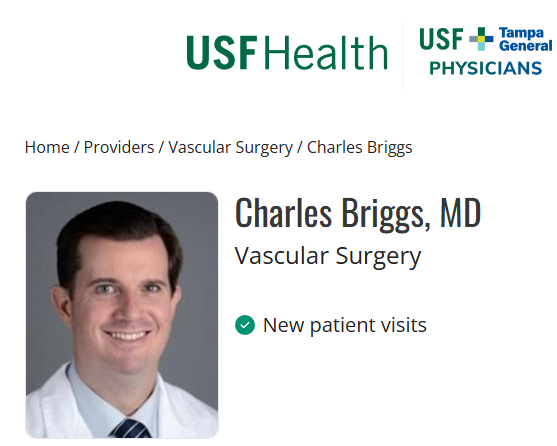
White Diamond Research interviewed Dr. Charles Briggs about the LIBERTY on 4/16/26. Below is his pic from the Tampa General Hospital website:
Source: usf.edu
The following are the most relevant parts of the interview:
WDR: How often are you using it (LIBERTY)?
Dr. Briggs: Uh, use it probably once every week, maybe?
WDR: You’re using it once a week. Is this requested by patients?
Dr. Briggs: Uh, no.
——– later during the call ——-
Dr. Briggs: …..So, for the last couple of months, probably 2 months now, I use it probably once every week, or every week and a half.
WDR: … I would just need to know if you want to remain anonymous.
Dr. Briggs: Uh, I don’t really… it doesn’t matter to me, I’m the only person that’s really using it, I think, so…
WDR: So do you envision this being across all procedures, or more so ones where the duration of the procedure is several hours, and you really don’t want to be wearing a lead vest for several hours? And then what percentage of those procedures would that account for?
Dr. Briggs: Yeah, sure, so I think if the technology catches up, you know, with where I hope it will get, or we’ll get to, um, I think it would be mostly, you know, helpful to replace the longer cases, particularly for the occlusions, uh, those reimburse a little bit better, number 1, and 2 you don’t have the [radiation] exposure.
WDR: You mentioned the word improvement. Um, what, like, sort of improvements…
Dr. Briggs: Yeah, uh, the… so the device is really, uh, can only use 014…wires and 014 catheters, and so, you know, the market leader in wires and catheters and balloons and things is actually 018, so 018, so those won’t fit through this… through this machine.
WDR: Like, what… does that cause complications for you?
Dr. Briggs: It doesn’t cause any complication, it just makes it a little bit harder to work with. The 014 stuff is a little bit flimsier, not as sturdy.
WDR: But does it save time, or it’s just pretty much the same?
Dr. Briggs: It’s pretty much the same. I mean, most of us, by hand, are pretty facile and can get across things pretty quickly. Um, the machine right now, for me is, uh, like, radiation reduction and being able to take off my lead.
WDR: I also found in my research, there’s companies, such as Salus Scientific, innovating lead vests that have, like, exoskeletons that are lighter weight, sort of like hiking gear.
Dr. Briggs: Yeah.
WDR: And that sort of seemed like an alternative to LIBERTY.
Dr. Briggs: Yeah, you know, it’s a… I think it’s a great question. Uh, we are currently in the process of renovating one of our hybrid rooms, and we’re installing the egg nest system, which supposedly reduces radiation by 99%, and you don’t have to wear lead in the room. Um, so, I mean, there are definitely other systems that are gonna be helpful.
Interview with A Former Microbot Medical Employee
We were able to interview a former employee who was involved with commercialization planning, launch readiness, and shaped the go-to-market strategy. He asked to be anonymous.
WDR: Do you mind providing a little bit of color on why you left Microbot?
Former Employee: Ultimately, I’ll be fully transparent. I think there was a misalignment between the way that they like to do business, and what I think is the right way to do business. And, um, you know, I could go into more detail, the CEO, he, he had, uh, I got, I want to be careful in how I say it. He just had ways of dealing with customers that, um, I felt were more hurtful to, um, the company, than helpful, um, you know, a very hard line on certain things, very, um, almost threatening at times on on the way that he does business. And I said, this is not how I do things. So I moved to my next opportunity.
WDR: Yeah, that sounds like a good reason to move on, gotta be aligned with ethics when you’re working with a company.
Former Employee: It’s the most valuable asset we have is our reputation, and, you know, I brought physicians that I had partnered with for years in to see him, and then we’d have a beer or a coffee afterwards, and they’d tell me, yeah, this is not comfortable. So I heard enough of that and I said, that’s not worth risking my, you know, 20 years name.
It was nothing but really a business decision and just misalignment. One of the challenges, and something that you just said already, is that they did not have a specific reimbursement, and you don’t have to have that, but you have to have a plan for that.
WDR: And they didn’t have a plan?
Former Employee: I felt that they didn’t have the right plan.
WDR: Why is that?
Former Employee: Um, you, you know, you could have the best device in the world, but if it just is absolutely economically unreasonable, then the hospital’s not going to sign off on it. You could have the cheapest device in the world, but if you don’t have a physician who’s gonna use it, then they’re not gonna push the hospital to adopt it. And if it doesn’t provide, uh, patient, better patient outcomes or some other aspect of care, lower uh, length of stay or reduced free admissions, there’s a lot of other ways that you can validate that side of it.
In Real World Use, The LIBERTY Doesn’t Have A Reduced Radiation Advantage
As Dr. Briggs said in the interview above, the LIBERTY can only push the smaller caliber guidewire (.014″). This is a specialty wire used by doctors in occlusion crossing part of peripheral vascular procedures. .014” wire is too flimsy (not capable of transmitting push required for wire advancement) for many patients/anatomies. The number of these wires sold for peripheral procedures is less than .018″ wires, that have a bigger diameter and are still the main guidewire used to perform peripheral vascular procedures.
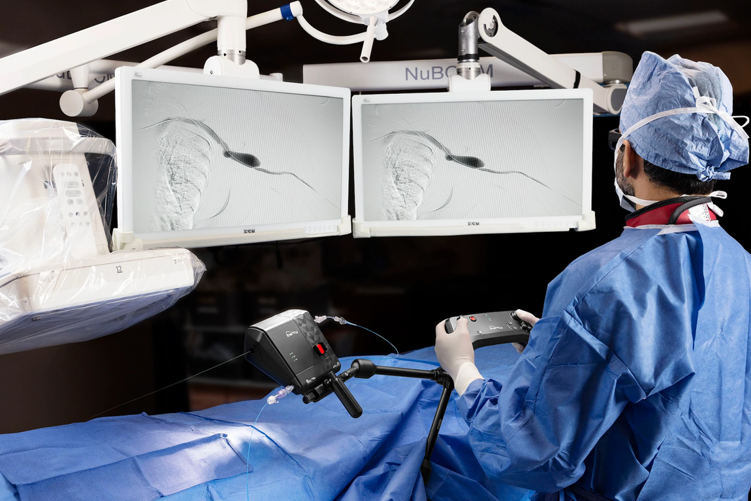
The .014” wires are often used in cardiac procedures, but these procedures are quick and expose the physician to a lesser level of radiation according to Dr. Briggs. So LIBERTY today is a toy technology that adds 15 minutes of set up plus other inconveniences of setting/unsetting, but it is not used throughout the surgery. The physician still needs to wear heavy lead (see the red lead vest behind the surgeons neck in the image below) for the rest of the procedure to protect against radiation. So with today’s .014″ wire limited LIBERTY, there is not even the radiation exposure advantage. When MBOT claims 92% radiation reduction, they just mean 92% less while using the LIBERTY, not 92% less of total radiation exposure. The physician still needs to handle the high caliber guidewires under normal radiation exposure, balloon catheters and other equipment that the LIBERTY is incompatible with.
The LIBERTY Doesn’t Receive Medical Reimbursement
The New Technology Add-on Payment (NTAP) code is very difficult to get. Everybody wants it and it is only given if 3 requirements are met:
- Newness (The technology has only been on the market for 2-3 years) – the LIBERTY qualifies.
- Technology is very expensive – the LIBERTY qualifies.
- Substantial clinical improvement: The technology must demonstrate a significant improvement in clinical outcomes compared to current, standard treatments – the LIBERTY doesn’t qualify.
According to the NTAP Reimbursement Approval Timeline, MBOT would have to submit the complete application by October 2026 to be considered for a 2028 Reimbursement Year, which starts in October 2027. Without Peer Reviewed White Papers and supporting real world evidence, the application will be weak and likely rejected.
While the LIBERTY has FDA 510(k) Clearance, it does not have any special designations from the FDA, which would be important for improving their chances of receiving NTAP code reimbursement. Furthermore, to receive agency buy-in and support from the American Medical Association, they should have peer reviewed white papers and real world evidence of clinical benefits published in academic journals to support their NTAP application, of which they have neither.
NTAP is also applicable for only inpatient treatment. Therefore, the patient would have to stay in the hospital overnight. However, our sources confirmed the majority of vascular and interventional radiology procedures handled by the LIBERTY are outpatient procedures.
Microbot Medical Is An Almost Identical Scenario To XACT Robotics
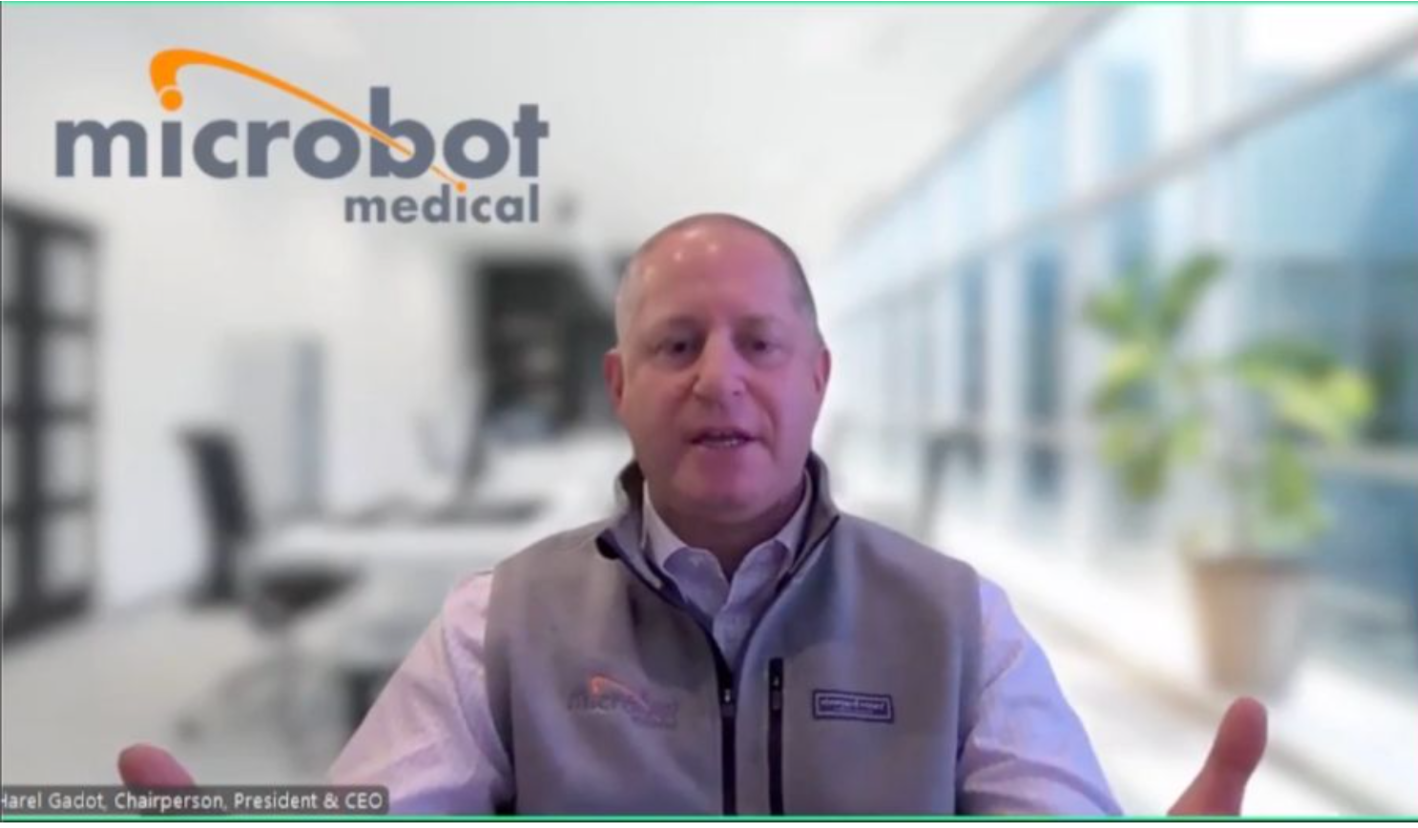
Mr. Harel Gadot founded MBOT in 2011 and he also founded XACT Robotics in 2013. Gadot is shown below:
Source: Needham Virtual Healthcare Conference Presentation on 4/15/26
MBOT has the LIBERTY Robotic System, XACT Robotics has the XACT ACE Robotic System. They are both used in vascular surgery.
The XACT ACE Robotic System first received FDA Clearance in 2020. The article states:
“The hands-free, tablet-sized robot with the potential to democratize percutaneous interventional procedures is on the verge of disrupting the U.S. interventional radiology market. After winning FDA clearance last year for its first robotic system, XACT Robotics recently scored FDA clearance for ACE, a second-generation robotic system.”
An update of the XACT ACE Robotic System received FDA Clearance in 2022. As stated in the PR:
“The first-of-its-kind feature for CT-guided percutaneous procedures is designed to improve physician workflows while limiting physician and other users’ exposure to radiation and reduce physical strain.
The addition of ACE Xtend has the potential to further increase efficiencies for the care team with a streamlined workflow that helps reduce the time in which physicians and other users are exposed to harmful radiation during standard procedures.”
As stated above, like the LIBERTY, the XACT ACE also touted its ability to reduce radiation exposure. But that benefit alone wasn’t enough for it to be a commercial success.
XACT Robotics Shut Down About 4 Years After It Received FDA Clearance, We Believe Microbot Medical Is On Track To Do The Same
On 9/3/23, XACT Robotics announced it’s shutting down the company and laying off all of its 65 employees.
The article states:
“The Israeli company has developed FDA approved autonomous robots for performing hands-free surgery but has failed to generate significant revenue.”
After receiving FDA clearance in late 2019, it took about 4 years for XACT Robotics to shut down.
As Gadot stated in his Needham Healthcare Virtual Conference presentation on 4/15/26, MBOT’s expected burn rate in 2026 and after is $30M per year. That’s a massive amount of money burned to market an impractical device.
At its current cash level of about $70M, that’s only a little over 2 years of cash left. Assuming they raise a little more cash using their ATM, they are on track to be out of cash in a few years, just like XACT Robotics.
On 4/10/26, MBOT filed that they will be able to sell $39M worth of shares in the open market at anytime, with an at-the-market offering “ATM”.
Our $1 Price Target Values Microbot Medical At, Or Slightly Below, Cash Value
In late 2026, MBOT will have about $1 per share in cash. We think trading at slightly below cash value is a fair value. In its current form, we believe the LIBERTY will be a commercial failure and the company will continue to lose money until it goes bankrupt. However, because of the possibility of an eventual improvement in the LIBERTY which could lead to it becoming commercially viable, we don’t believe the stock should be trading far below its cash value. That said, the company hasn’t made any statements in regards to the need to significantly improve the device. The more days that go by without significant improvement in the LIBERTY, the less the company is worth.
Conclusion
Our research found that the LIBERTY is uneconomical and doesn’t have any significant benefits for a patient compared to the standard vascular surgery procedure. As a result, we believe that the only sales that MBOT will get are to academic hospitals. The two hospitals that MBOT reported by name that have purchased the LIBERTY are Emory and Tampa General. Both are academic, non-profit, hospitals. Emory Healthcare is part of Emory University and Tampa General is the primary teaching affiliate of USF Health Morsani College of Medicine.
One of their goals is to attract and educate medical students, and path the way for advanced telerobtics, so they can purchase the latest new technologies even if they aren’t practical or lose the hospital money compared to the previous standard procedures.
That said, it doesn’t mean that the academic hospitals that decide to purchase the LIBERTY will use it very much. Tampa General Hospital has 15 vascular surgeons, and Dr. Briggs says he’s the only one who really uses it. And the anonymous surgeon we interviewed stated:
There’s no reimbursement mechanism, right? So, they’re asking you to do a case and buy this thing, and add, you know, $3,000, $4,000 to the cost of a case.
Some uniformed investors might invest in MBOT just because it’s a new invention in healthcare robotics. But the LIBERTY is much different than Intuitive Surgical’s da-Vinci robotic surgical system. The da-Vinci has many proven clinical benefits to the patient, such as smaller blood loss, shorter operation procedures, better optical views for physician, etc.
The majority of da-Vinci’s expense is capital, not disposable like the LIBERTY. It took Intuitive Surgical, a well-funded and uniquely disciplined pioneer, decades to get its technology adopted. There were dozens of robotic companies that failed after the da-Vinci. We believe MBOT’s LIBERTY will fail as well.